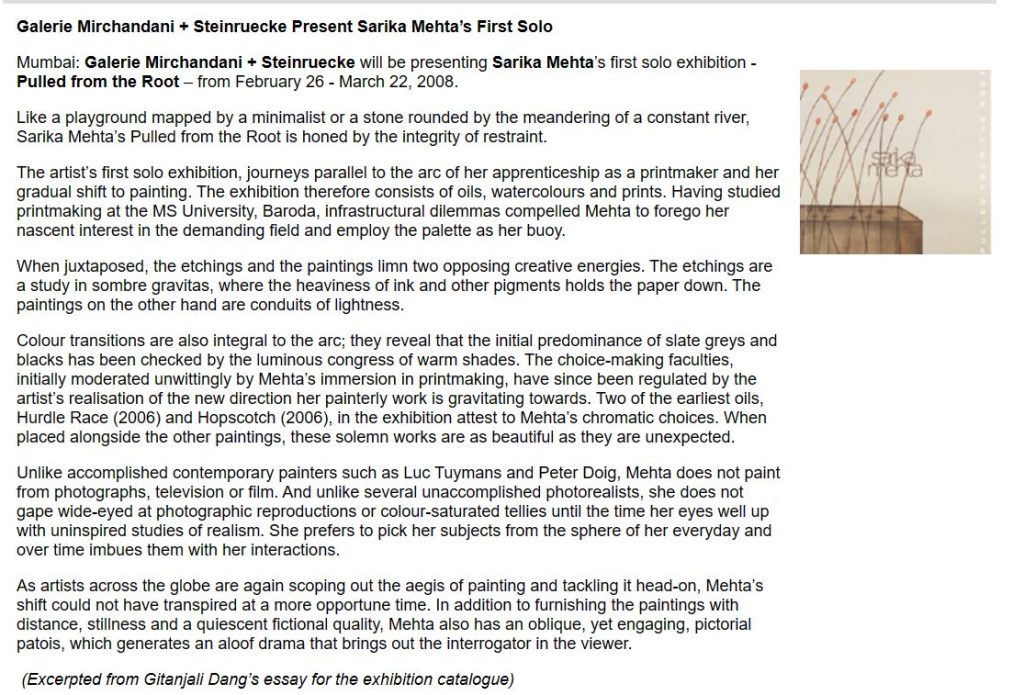
Sarika Mehta
Sarika Mehta
Pulled from the roots
Picture this…
Gitanjali Dang
Like a playground mapped by a minimalist or a stone rounded by the meandering of a constant river,
Sarika Mehta’s Pulled from the Root is honed by the integrity of restraint.
The moment I stepped into Mehta’s studio in suburban Ahmedabad, a juxtaposition of rare candour sought
my attention. Not far above the painting Noah’s Ark, a few mangled wooden reeds were suspended from a
nail in the wall. They, however, were not seized by the part-menacing and the part-brooding air of things,
which have suffered neglect. That said it was unclear if this object, previously known as chime, had come
undone because of ill-mannered weather or if the artist’s probing hands had nudged it to its condition of
disrepair.
Elsewhere in Mehta’s studio, placed in an underpass created by the incline of one of her larger canvases,
was a sound system. From it reverberated Abida Parveen’s lugubrious voice. The Sufiana singer’s vocals
were mentoring the words to a track from her album Raqs-e-Bismil (Dance of the Wounded). As Parveen’s
voice perforated the nip of the November air, it became apparent that music is integral to the artist’s
practice. The motifs in Mehta’s works are delivered on bobbing crests of sound; both are deeply
intertwined.
Whether from the recesses of a broken chime or from the ecstatic core of Sufiana tradition, music in
Mehta’s work is like an umbrella containing the dialectics of rooted ness and rootless ness. The subjects in
the paintings and the etchings, having been pulled from their milieu, are grounded by the artist in the
fictive space of her paintings.
The artist’s affinity for music could be used as a device to explain the process by which she integrates her
cast of characters into her pictorial researches. Mehta’s work gains impetus from aleatoric art. Several
musicians including John Cage, Pierre Boulez and Karlheinz Stockhausen have been preoccupied with this
form of art, which plumbs the depths of randomness or chance and creates a collage thereof. By rolling
the dice as it were, Mehta appears to layer her work in a manner similar to that espoused by these
musicians.
Unlike accomplished contemporary painters such as Luc Tuymans and Peter Doig, Mehta does not paint
from photographs, television or film. And unlike several unaccomplished photo realists, she does not gape
wide-eyed at photographic reproductions or colour-saturated tellies until the time her eyes well up with
uninspired studies of realism. She prefers to pick her subjects from the sphere of her everyday and over
time imbues them with her interactions.
Her reasons for doing this are Heraclitean. According to the pre-Socratic Greek philosopher Heraclitus, “We
both step and do not step in the same rivers. We are and are not.” In the observation it is apparent that
the river indicates time and that we change with the passing of each moment. Judging by her loyalty
towards the Heraclitean philosophy, it is tough indeed for Mehta to reconcile herself to mass media images
that clamour to freeze reality.
These objects/subjects necessarily lose their sharp-edged identities and voices when they enter the
atmosphere of Mehta’s pictorial realm. Their original identities muffled, they don’t treat their new identities
with suspicion or read them as though they were crises.
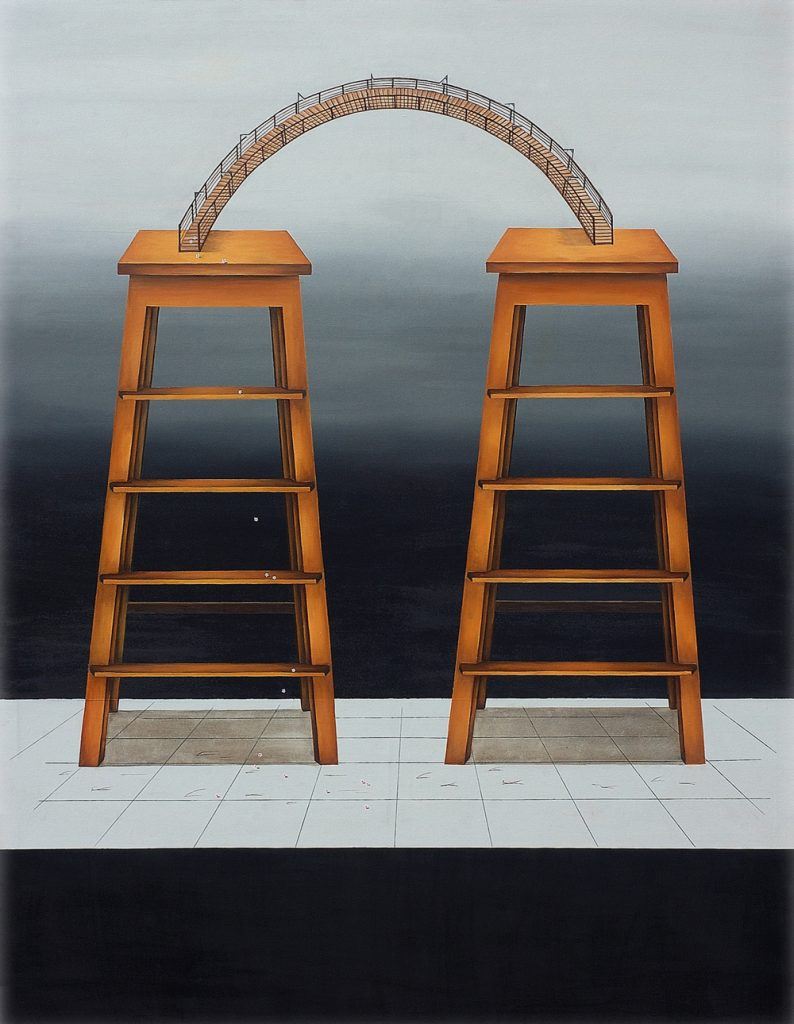
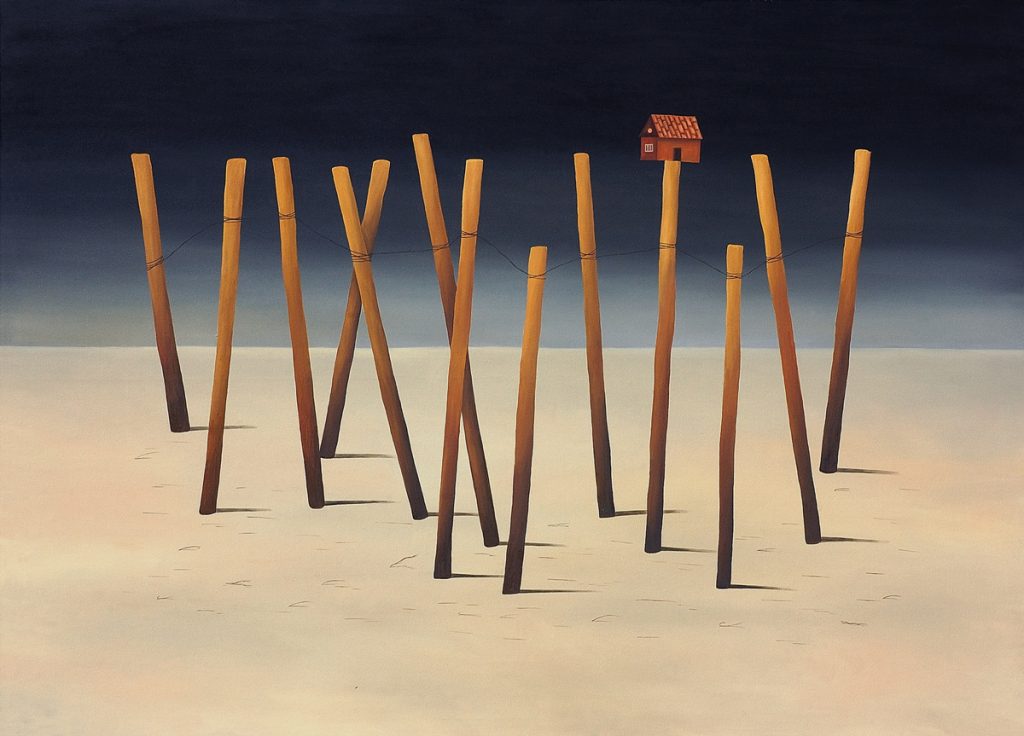
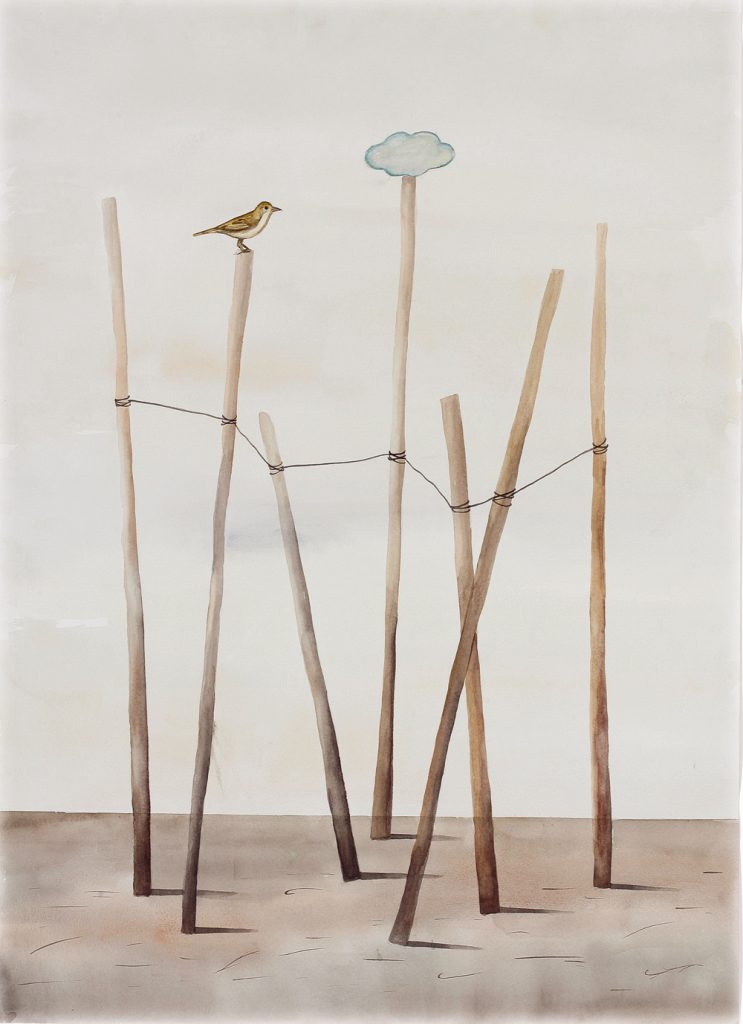
In the paintings, the broken chimes transmogrify into hurdles, stilts, anchors and even nunchakus. The
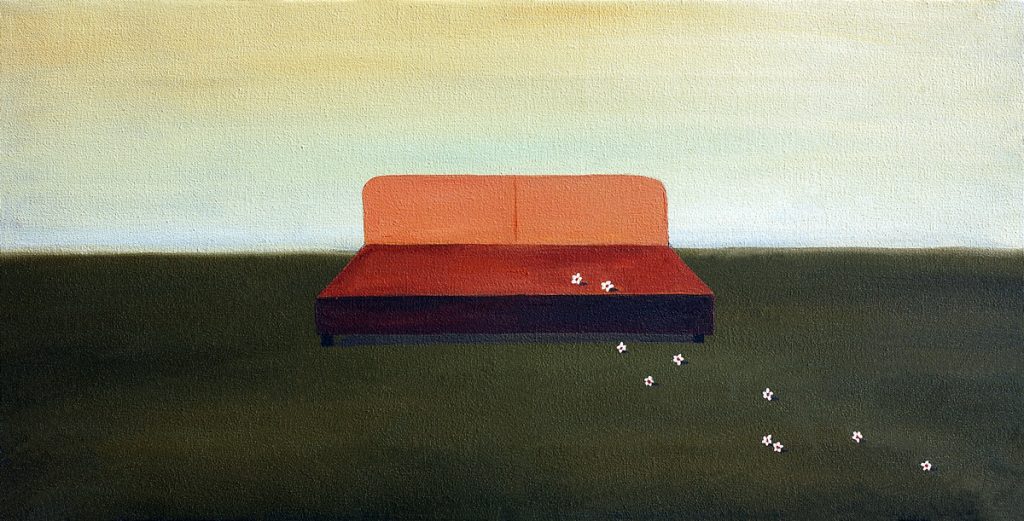
flowers that populate several of Mehta’s works with their benevolent thistledown-like presence do not grow
from nature; they are the artist’s hybrid design and preoccupation. In the etching Once Upon A Time
(2003), the anonymous little girl who with her back to the viewer keeps a tab on all whimsies conceived in
her head by maintaining a stream of doodles is Mehta’s relative. Handpicked by the artist, she was quickly
inducted to play games that were curated by her and would eventually seep into her work.
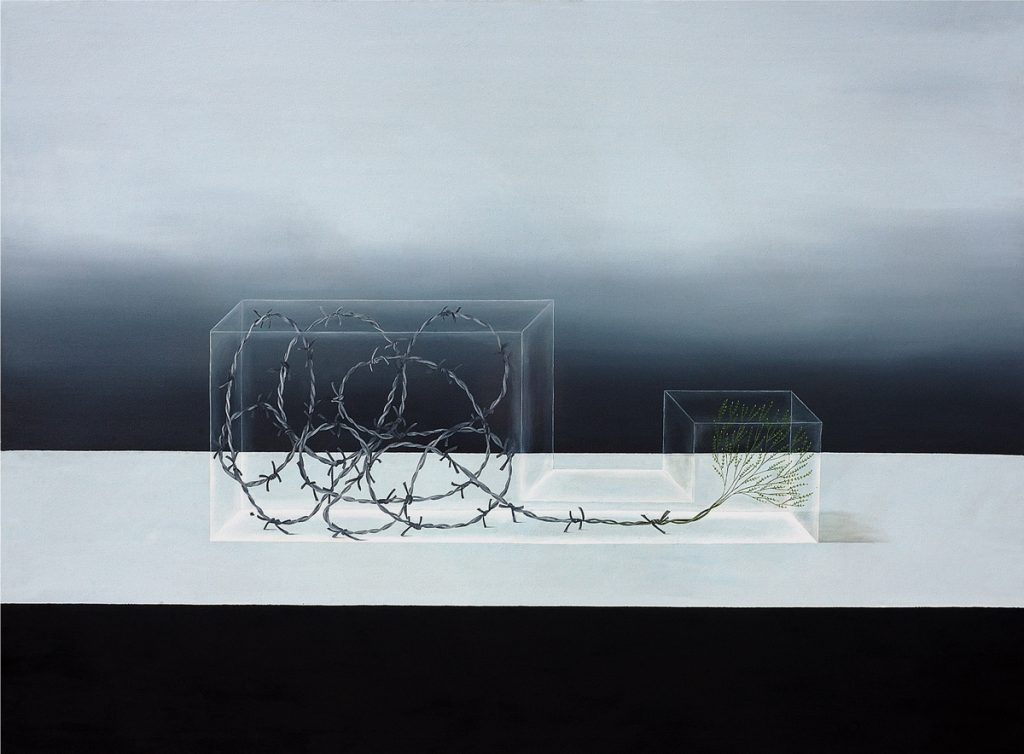
On occasion, these transformations occur in full view. In Grafting (2007), an enchanting case of Dr Jekyll
wi. dyde unravels when a tangle of barbed wire slithers out of its punk skin only to allow the
and Mr Hyde unravels when a tangle of barbed wire slithers out of its punk skin only to allow the
greenness of a waifish sapling to take over.
241° $5 Of a waifish sapling to take over. A green house experiment gone wrong or right, depending on
which side you take, Grafting is that rare instance where Mehta makes the viewer privy to her cognitive
prucess.
green house experiment gone wrong or right, depending on
which side you take, Grafting is that rare instance where Mehta makes the viewer privy to her cognitive
process.
The artist’s first solo exhibition, journeys parallel to the arc of her apprenticeship as a printmaker and her
gradual shift to painting. The exhibition therefore consists of oils, watercolours and prints. Having studied
The artist’s first solo exhibition, journeys parallel to the arc of her apprenticeship as a printmaker and her
Graduu, Shift to painting. The exhibition therefore consists of oils, watercolours and prints. Having studied
The artist’s affinity for music could be used as a device to explain the process by which she integrates her
cast of characters into her pictorial researches. Mehta’s work gains impetus from aleatoric art. Several
musicians including John Cage, Pierre Boulez and Karlheinz Stockhausen have been preoccupied with this
form of art, which plumbs the depths of randomness or chance and creates a collage thereof. By rolling
the dice as it were, Mehta appears to layer her work in a manner similar to that espoused by these
musicians.
Unlike accomplished contemporary painters such as Luc Tuymans and Peter Doig, Mehta does not paint
from photographs, television or film. And unlike several unaccomplished photo realists, she does not gape
wide-eyed at photographic reproductions or colour-saturated tellies until the time her eyes well up with
uninspired studies of realism. She prefers to pick her subjects from the sphere of her everyday and over
time imbues them with her interactions.
Her reasons for doing this are Heraclitean. According to the pre-Socratic Greek philosopher Heraclitus, “We
both step and do not step in the same rivers. We are and are not.” In the observation it is apparent that
the river indicates time and that we change with the passing of each moment. Judging by her loyalty
towards the Heraclitean philosophy, it is tough indeed for Mehta to reconcile herself to mass media images
that clamour to freeze reality.
These objects/subjects necessarily lose their sharp-edged identities and voices when they enter the
atmosphere of Mehta’s pictorial realm. Their original identities muffled, they don’t treat their new identities
with suspicion or read them as though they were crises.
In the paintings, the broken chimes transmogrify into hurdles, stilts, anchors and even nunchakus. The
flowers that populate several of Mehta’s works with their benevolent thistledown-like presence do not grow
from nature; they are the artist’s hybrid design and preoccupation. In the etching Once Upon A Time
(2003), the anonymous little girl who with her back to the viewer keeps a tab on all whimsies conceived in
her head by maintaining a stream of doodles is Mehta’s relative. Handpicked by the artist, she was quickly
inducted to play games that were curated by her and would eventually seep into her work.
“=ce-75ion, these transformations occur in full view. In Grafting (2007), an enchanting case of Dr Jekyll
atid
printmaking at the MS University, Baroda, infrastructural dilemmas compelled Mehta to forego her nascent
interest in the demanding field and employ the palette as her buoy.
Although the recent past has had Mehta disengage from printmaking, she will soon embark on a new
project, which will focus on etchings. That said she has been working on a selection of dry point etchings
done on acrylic sheets. These fragile etchings elaborate the same subject matter as her paintings; only
they are devoid of colour and enamoured of lines.
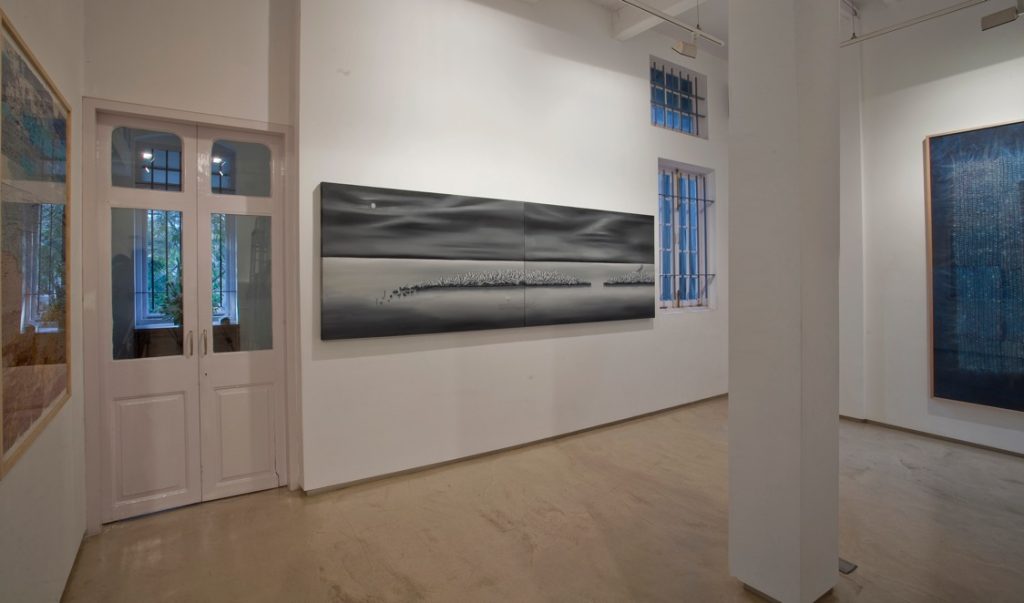
When juxtaposed, the etchings and the paintings limn two opposing creative energies. The etchings are a
study in sombre gravitas, where the heaviness of ink and other pigments holds the paper down. The
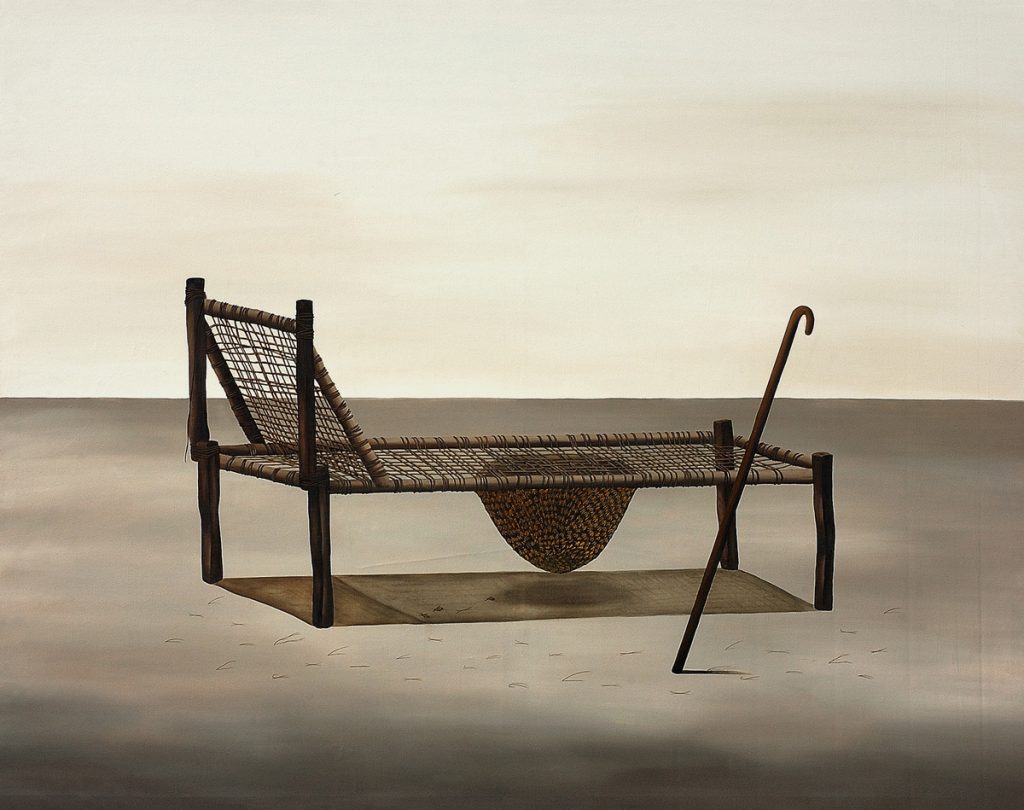
paintings on the other hand are conduits of lightness.
Colour transitions are also integral to the arc; they reveal that the initial predominance of slate greys and
blacks has been checked by the luminous congress of warm shades. The choice-making faculties, initially
moderated unwittingly by Mehta’s immersion in printmaking, have since been regulated by the artist’s
realisation of the new direction her painterly work is gravitating towards. Two of the earliest oils, Hurdle
Race (2006) and Hopscotch (2006), in the exhibition attest to Mehta’s chromatic choices. When placed
alongside the other paintings, these solemn works are as beautiful as they are unexpected.
As artists across the globe are again scoping out the aegis of painting and tackling it head-on, Mehta’s
shift could not have transpired at a more opportune time. In addition to furnishing the paintings with
distance, stillness and a quiescent fictional quality, Mehta also has an oblique, yet engaging, pictorial
patois, which generates an aloof drama that brings out the interrogator in the viewer.
In Mehta’s work, one could read an elegy to Alexander Calder’s chime-like wiry mobiles. It is almost as
though a rascal wind had cut through and unravelled Calder’s sculptures and the disarticulated birds,
homes, reeds and flowers, had descended into Mehta’s work. Devoid of their giddying motion, these
objects are entrenched in a terra firma that is no less rich than flesh.
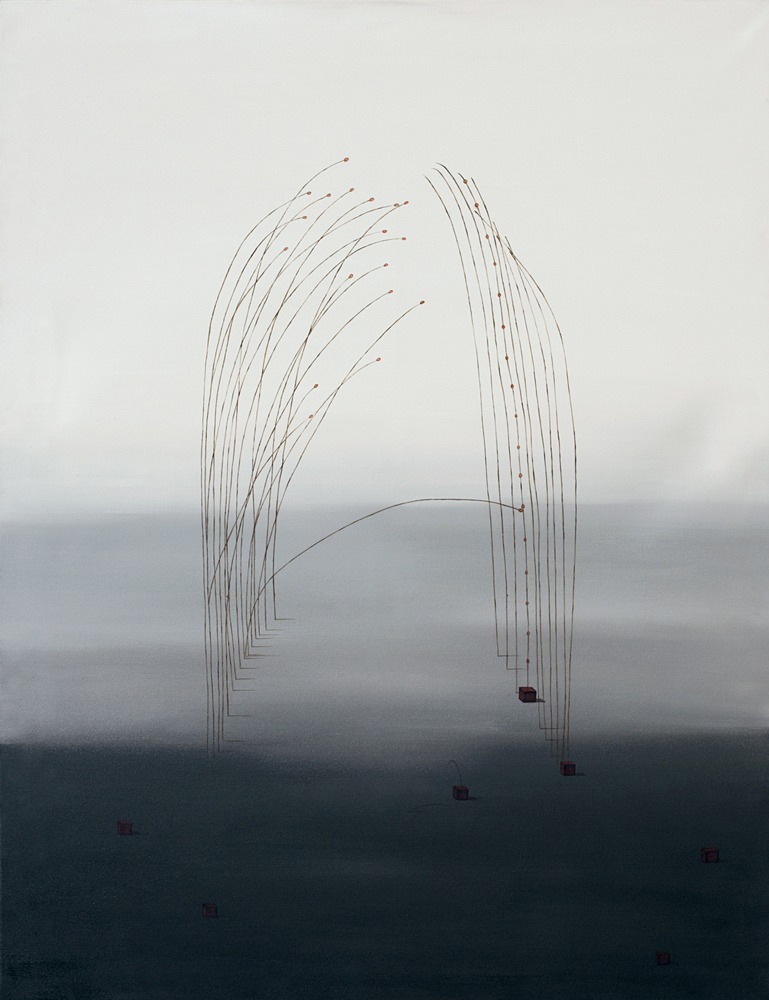
As the earth crumbles and makes way for flesh, the wistfully compact strokes, which populate most of the
canvases, adopt the mantle of emoticons in Pulled from the Root. They could be perceived as a
continuation of Mehta’s already established streak of engagement with nature, in that they could easily be
recognised as blades of grass. But I would like to propose that we identify them as deracinated hairs or
brisling hairs, standing on edge. It’s almost as though Parveen’s voice had wafted across the canvas and
caught them unaware.
The hair, a motif of slow-burning melancholy, has settled into the paintings and prints like downy soot.
When the motif is read concurrently with Mehta’s love of the robust vocals and the mesmeric kalams of
Sufiana singers and poets such as Parveen and the 17th
century saint-poet-mystic Baba Bulleh Shah,
Pulled from the Root transforms into an enchanted playground where visual conundrums replace jungle
gyms and seesaws.
Having always been drawn to sports, playgrounds and racetracks become like catnip to Mehta. They enter
her work not as Olympian hurdles but as teases that impel the scene around them to take shape. Mehta’s
painterly disposition is mostly enthralled by playgrounds dense with sedate sunlight. But the artist has
made allowances, in some of her paintings, as also her prints, for zippy tracks where racing cars and
skates chase each other feverishly in a bid to vanquish the finishing line.
In 2003, while she was still studying printmaking at the university, Mehta made the etching Extension
(2003). In this mystifying sepia-coloured print, we encounter two doorways. The one to the side floats
shadows from its interiors into the foyer, whereas the other, whose insides happen to be directly in our line
of vision, reveals a lone abacus. In the foreground of the passageway, beads/seeds that have separated
from the abacus can be found. The abacus and the seeds could be perceived as time itself. With an
unknown visitor to the room setting himself the task of tracking time and day with help from the abacus.
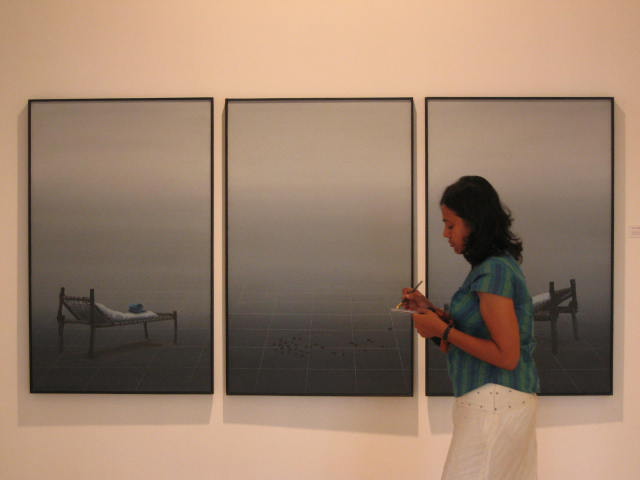
That the introverted seeds from the earlier print are strategically strewn or placed in Falling Moon (2007)
and in Something Substantial (2007) is no coincidence. Although the fingerprints of time can be found on
no other print or painting in the exhibition, its omnipresence can never be questioned. Certain raised
eyebrows may query, “Why then has Mehta decided to eject this integral motif from her work?”
The disappearance of the time motif recalls Mark Strand’s poem, Keeping Things Whole (1)
In a field
I am the absence
of field.
This is
always the case.
Wherever I am
I am what is missing.
When I walk
I part the air
and always
the air moves in
to fill the spaces
where my body’s been.
We all have reasons
for moving.
I move
to keep things whole.
With its ambiguity and its staunchly metaphysical temperament, Keeping Things Whole often startles. In
some oblique manner, however, it also resonates the tenor of the exhibition. In addition to her visually
centred creative works, Mehta also writes poetry, albeit at an informal pace. Often objects and themes,
found and otherwise, waltz into her poetry first and then proceed to occupy her paintings. Undoubtedly
metaphysical, the artist’s poetry reads as a valid preamble to her visual vocabulary.
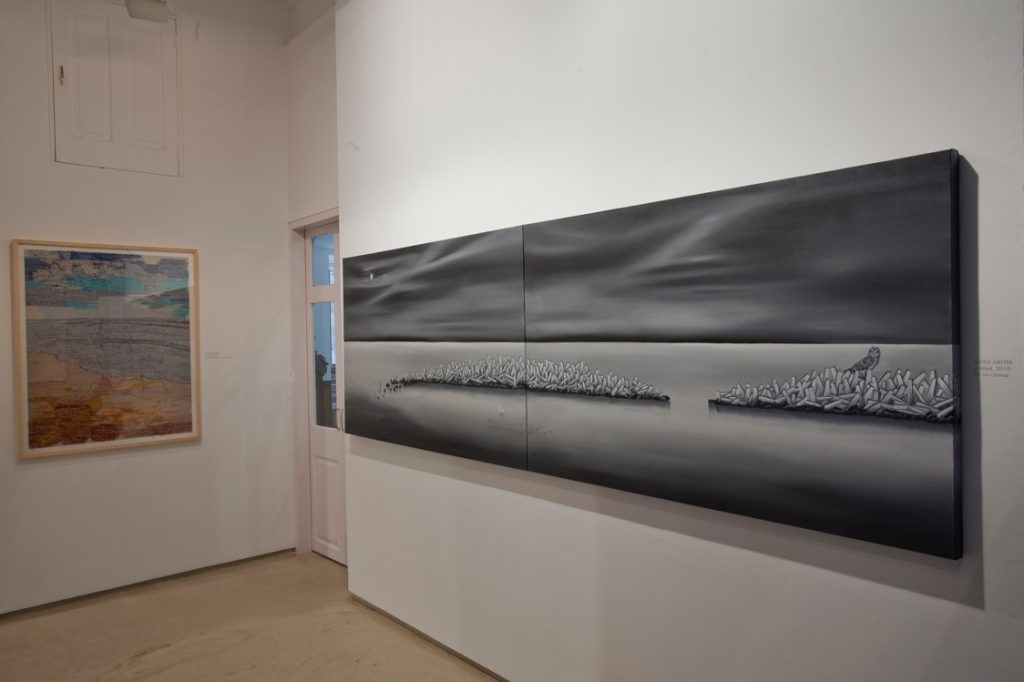
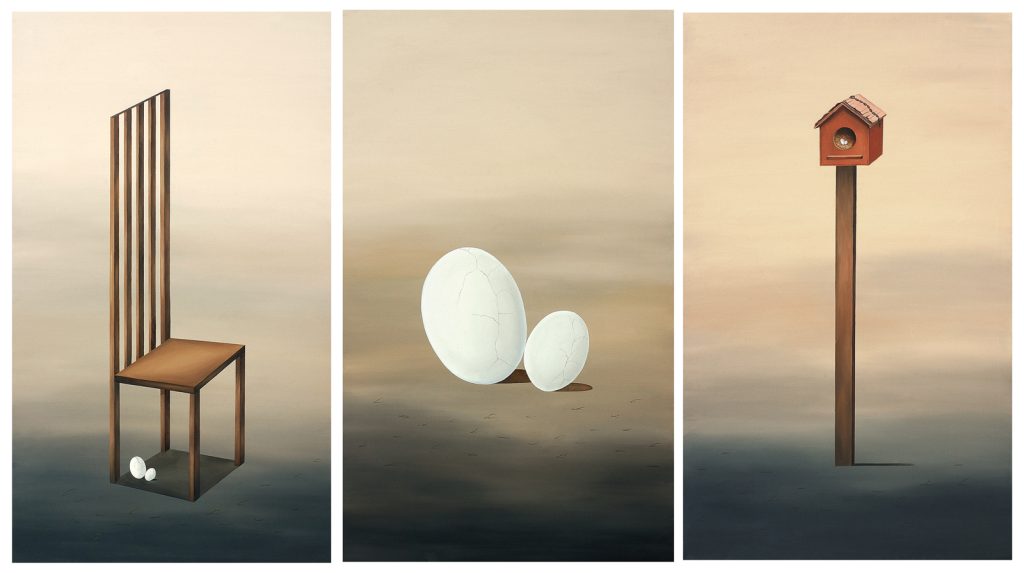
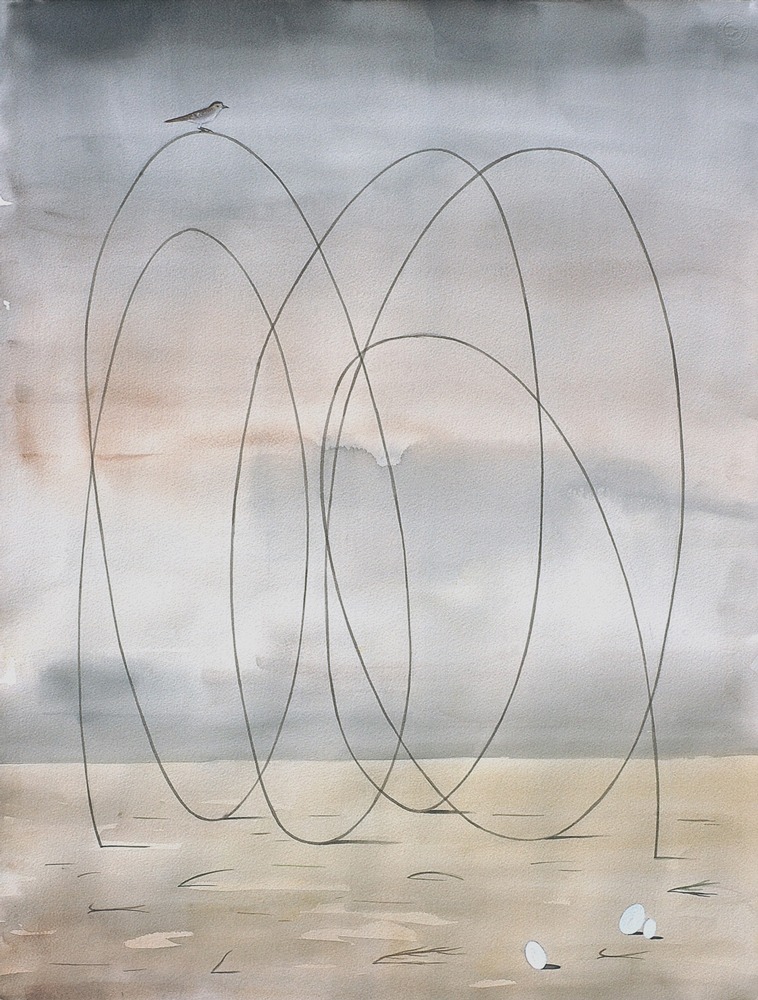
The perfectly metaphysical egg is the motif next in line after hairs, games and time. The voice of the
quirky Icelandic singer Björk would be the perfect vehicle for this motif. The painting On a Leash (2007),
in fact claims an image Björk would want to possess. The represented eggs are not pristine. The cracks in
their shells threaten to give way and would disintegrate if touched by the high-pitched vocal stylisations of
Björk. It would not be entirely surprising if the eggs hatched the currently invisible seeds of time.
The vistas, dominated by waiting-to-hatch eggs, may at first sight be reminiscent of Salvador Dalí’s
mutant creations. Not without some hesitation do I bring in the mention of Dalí and his sinister
landscapes. The mere suggestion that Pulled from the Root could trace its ancestry back to Surrealism is
grotesque and harsh. Despite the peculiar character of the juxtapositions and the vaporisation of the
original attributes of the subjects, Mehta’s paintings are metaphysical quandaries, not surreal
envelope-pushers.
In conclusion, it was in the 1980s that some theoreticians had first announced the theme of the death of
painting. This declaration hinged from the opinion that the painting had reached the end of its road, and
neither a Jackson Pollock nor a Robert Ryman would be able to fire it up again.
Since there have been several such thought based upheavals, most notable being the observation about
the end of art, made by art historians Arthur C Danto and Hans Belting.
Danto writes, “Ours was a claim about how one complex of practices had given way to another, even if the
shape of the new complex was still unclear – is still unclear… For I was writing about a certain narrative
that had, I thought, been objectively realised in the history of art, and it was that narrative, it seemed to
me, that had come to an end. The story was over. It was not my view that there would be no more art,
which “death” certainly implies, but that whatever art there was to be would be made without benefit of a
reassuring sort of narrative in which it was seen as the appropriate next stage in the story. What had
come to an end was that narrative but not the subject of the narrative.” (2)
Although Danto has clarified that it was never his intention to suggest the demise of art, he has indeed
indicated at the end of a certain “reassuring sort of narrative”. I would like to counter these statements by
suggesting that Danto holds a very Judeo-Christian view of a grand narrative. The narrative did not end;
on the contrary it grew tributaries.
The paintings by Mehta, Doig and Tuymans among others belong to that very same narrative whose death
Danto has claimed. Their engaging bodies of work have helped maintain painting and furthered the
narratives of art.
Notes
1 Mark Strand, ‘Keeping Things Whole’ from Selected Poems, (Alfred A. Knopf, 1980)
2 Arthur C Danto, After the End of Art: Contemporary Art and the Pale of History (Princeton University Press, 1997)
Gitanjali Dang is an independent curator and critic. She was the art critic at Hindustan Times from 2005 to 2008. She has a Masters in English Literature and a Diploma in Indian Aesthetics (Mumbai University).